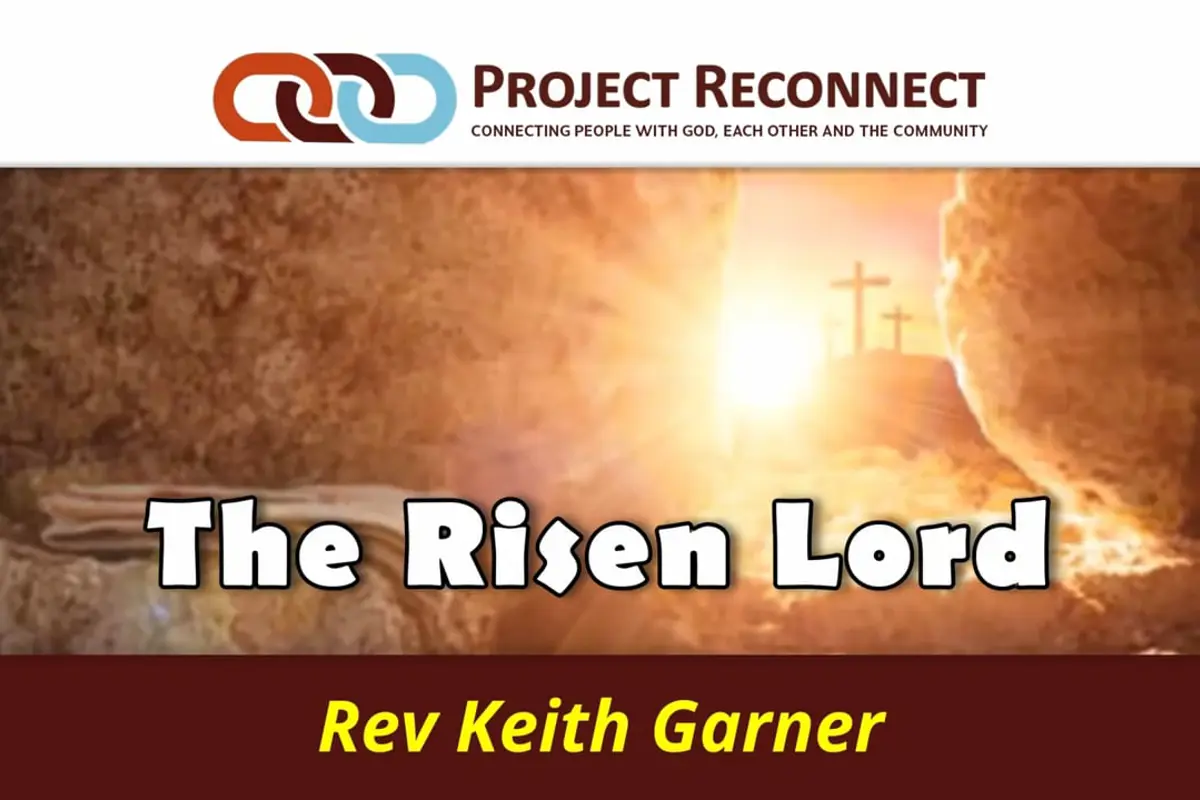
Matthew 28:1-10
No Tomb Can Hold Him: The Power of Easter
Exploring Matthew's bold and dramatic account of the resurrection, we discover that Easter is not a detached event but God meeting us in the toughest places of life, transforming death into a new beginning.
Easter at the Heart of Our Faith
Very happy Easter to you. This morning I'm turning to Matthew's account of the resurrection — unique in its own way, probably the most engaging, the most exciting, and the most unambiguous of all the resurrection accounts. But like all the accounts, it is pivotal to understanding the ministry of Jesus and what the message has to say to us today.
We remind ourselves of that truth found in 1 Corinthians: If Christ has not risen, then our faith is futile.
Matthew's account is possibly preached less frequently than the others, perhaps because of its more dramatic elements — the earth-shattering earthquake, the angel descending. But it seems to me it has a message all of its own. We focus on the big, bold strokes of Easter, but we also focus on the people engaged and involved in a very real and personal way.
The Empty Tomb
Consider the two women — Mary Magdalene and the other Mary — who witnessed the risen Lord and discovered the empty tomb. It is wonderful that the women are there at the very beginning. The angel points to the earthquake as important, the stone rolled away. Through the women, we learn that Jesus Christ has been raised.
The angel invited the women to see the place where Jesus had lain — a familiar place. Then he encouraged them to go and tell the disciples. They are filled with joy and leave quickly.
In Matthew's telling, the women don't primarily bring spices to the tomb. They bring themselves. And when they come to observe, to discover that tomb, it is the dawn of a new day, a new week. It is, in fact, a new beginning — a new beginning for them, a new beginning for me, a new beginning for you.
There was no expectation that they would see him raised. The tomb had only been sealed two days earlier. The sense of challenge, the sense of mystery, the sense of coming to that place is important.
These women are the first post-resurrection witnesses. What a marvellous picture — people who were not always listened to, who were not always regarded as having significance and worth, and yet here they are as the first witnesses to the resurrection. That is a great challenge to all of us.
Jürgen Moltmann, the German theologian who has inspired so many preachers over the years, captures the great span between Good Friday and Easter Day in these terms: "God weeps with us so that we one day might laugh with him."
What a transformation. What a change goes on in this Easter experience. Easter is not detached or irrelevant. It is in the tough places of life that we find resurrection. Resurrection is not just some nice story pulled from one corner and given meaning. Resurrection is God meeting us in the very places we need to find him — and finding in resurrection what it means to belong and to believe.
The Risen Lord
On the first day of the Jewish working week, the disciples are perhaps hankering for some kind of normality. However, nothing will ever be normal after Easter Day, for they come and see what it is to share in the glory of the risen Lord.
We're told in verse eight that the women hurried from the tomb, afraid and yet filled with joy. How is it possible to hold those things together? But it seems to me they are — that is the Easter story. There is fear, but there is joy. There is a sense of wonder that combines and drives them to respond positively, to go and tell the rest of the disciples what has happened.
Jesus greets them, and they came to him, clasped his feet, and worshipped him. In verse ten, Jesus says to them: "Do not be afraid. Go and tell my brothers to go to Galilee, and there they will see me." Twice they are told. The instruction of the angel is reinforced now in the words of Jesus himself.
Dietrich Bonhoeffer wrote a short confession of faith during the final days before he was executed, just twenty-three days before the end of World War II. He opened that confessional thought with these words: "I believe that God can and will generate joy out of everything, even out of the worst evil. For that, he needs people who will allow everything that happens to fit into a pattern for good."
The same writer concluded: "Death is the supreme festival on the road to freedom." Death to resurrection is, for the Christian, the heart of everything. I hope it is for you and for your church, as you start to capture what Easter is truly about.
A New Beginning
When we come to Easter Day, it is the celebration that death is now transformed into something far better. It is life itself — life that is transforming, life that is penetrating, life that brings peace and hope and a new beginning to a people.
Another writer, reflecting on this conclusion, said: "If he's wrong, all is lost. But if he's right, it's just beginning."
No tomb can hold Jesus Christ. No door will lock him in. This Easter, we reflect on a world that is so easily divided. When I consider the news of these past few weeks, there is certainly plenty that would make us feel sad. But on Easter Day, let us gather the thought that Christ has risen. Take that hope into our lives. Make the journey, as the women did and as the early disciples did, to see Jesus Christ and know him as the risen Lord.
Of course, everything is different — it is a different world. But we have never needed more than we do today the message of Easter and the power it brings into our lives.
God bless you this Easter with hope, with peace, and with love.