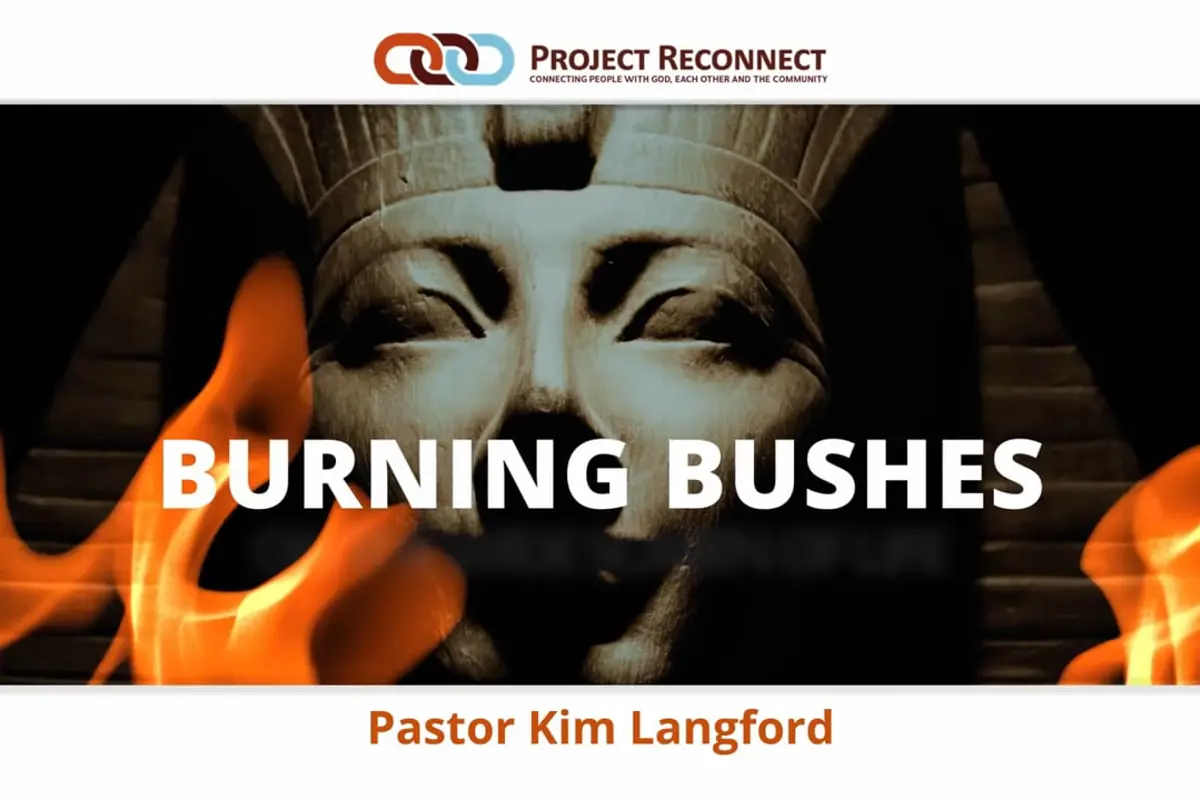
Exodus 3:1-15
Burning Bushes and Stumbling Blocks: When God Interrupts Our Ordinary
From Moses at the burning bush to Peter rebuked by Jesus, God's redemptive plans unfold through reluctant, fearful people—and through divine interruptions we must choose whether to notice.
A Murderer Meets His Maker
When Moses encountered God in the burning bush, he was on the run as a murderer. Before long, he would be meeting with God as God's prophet and God's friend.
How do you imagine Moses? I still remember the 1956 movie starring Charlton Heston as Moses and Yul Brynner as the glowering Pharaoh, engulfed in a rolling Hollywood tryst of power games, threats, and violence. But let's start with the very human elements of this story.
Exodus 2 creates a type of build-up and then unraveling in Moses. By killing an Egyptian and then trying to break up a fight between two Hebrews, we glimpse his fury at injustice. After living in royal privilege, he wants to do something about his people's suffering—something about the slavery and the hard labor.
When we meet Moses in the desert, he is exiled from his own people, from both his adopted Egyptian family and his Hebrew kin. Well before he leads the Hebrews out to the Sinai desert, he has already undergone a personal exodus, ending up beyond the wilderness. He expected to tend sheep, not realizing that God was preparing him to lead a very different flock. He sought obscurity and ordinary existence, not knowing that he would be set apart—not to return to royal Egyptian privilege, but to a dangerous human task.
A God Who Hears the Cries of the Oppressed
What picture of God do we see in this story? Firstly, God hears the cries of the oppressed as the Hebrew slaves simply cry out to the God they believe is there. Back in those times, where else could slaves turn?
God hears, and like a magnet, draws the cries of pain and suffering as these humans take the initiative and cry out in this raw way. This God—who will soon be known to Moses as Yahweh—is willing to enter the messy space of human suffering.
There will be cycles of obedience and blessing, falling away and judgment, repentance and restoration. Maybe we can trace that in our own lives. We might ask ourselves why God keeps coming back for more from us humans.
Walter Brueggemann argues that such perseverance is based on the tenacious fidelity of Yahweh—the creator's loving faithfulness that will not give up.
The Bush That Burned Until Moses Turned
How would these two distant scenarios—a people crying out in desperation and Moses traipsing along in the wilderness—ever merge?
God comes to Moses from the bush, not as a game of hide and seek, but with this tenacious fidelity. The bush burned without being consumed. But for how long? It might have been for five minutes, maybe five years. Ancient rabbis taught that this shrub was alight not just as an impromptu event—it kept burning patiently until Moses came and decided he must turn aside and look at this great sight.
Just think of Moses not turning to see the bush and walking on his not-so-merry but ordinary way. It's entirely possible for us to continue strolling past something that invites us to go off the beaten track. We can just keep strolling—or even scrolling—on, ignoring any of God's penetration into our lives as individuals and as a community.
God never compels by force. God persuades by love. In this case, love is a burning bush.
Where have you found something that stops you in your tracks and invites you to take stock of life?
"I Will Send You"
Here we see a truth that stretches out all the way to us across a wide scriptural arc. Bearing God's image, we participate in the very life of God, and this means that divine action and human willingness go together.
This sounds like a splendid arrangement, but it doesn't always land well. On first encounter, Moses is impressed, excited at what this God is saying. Yahweh says, "I will." Moses thinks, "That's great. Go, God, and I'll cheer you on." But then God says, "I will send you," and it starts to sink in. Moses tries to opt out of a plan he didn't realize he had opted into.
Then comes the promise that will echo down the ages:
"I will be with you."
The rest of Exodus is an account of this powerful and often uneasy encounter between humanity and the divine one, Yahweh. It is a fascinating story that shows the transformation of Moses. From retaliator, he was to become shepherd, peacemaker, advocate, and protector. Transformation was shaped by his encounter with the people—this new community that he was to build, the people he was called to serve. And transformation meant that his life was saturated with the reality of God.
From Stumbling Block to Solid Rock
In Matthew 16, we glimpse Jesus as the one whose whole being is saturated by the reality of God. But this proves uncomfortable for his companions.
In the rather shocking and jarring scene from today's reading, Jesus pushes back against Peter's attempts to make Jesus himself a more exciting and powerful Messiah. Jesus describes Peter not as a rock, but as a stumbling block—focusing on human things rather than divine things.
We know what it's like to stumble on something, whether it's part of a beautiful ancient cobblestone road that easily trips us up, or uneven loose pavers in our backyard.
Moses and Peter each had to choose whether to argue with God's salvation plan or to move with it. Peter, thinking he was following a politically triumphant Messiah, hears instead that he is following the Son of Man, the Son of God—a suffering servant who expects a humiliating death. Peter realizes afresh who it is he is following, and the stumbling block is eventually transformed to a solid rock.
We also might balk at Jesus' path, yet he's the one we have chosen to follow. Isn't he? Can Jesus' words get past our ears and enter deep into our hearts? Tell Jesus your hesitation, your worries about what this following means. But let's commit to following him, even when the ride seems bumpy, unfamiliar, and way past our compass bearings.
The Three-Miles-Per-Hour God
As you have listened to these scriptures, what do you think of God's plans for redemption through the fearful, stammering Moses and the divine suffering Son of God?
God's promises can seem like a very slow train coming in. Kosuke Koyama once described God as the "three miles per hour God"—who moves at the pace of humans, at an ordinary, everyday pace. God would travel with the Israelites as they walked the wilderness. Jesus was an itinerant Lord who moved around and noticed what was going on in the neighborhood. Jesus' parables speak of the strangely ordinary ways God transforms our world.
There are two helpful ways we could consider this:
- The undercurrent: The promises of God are like the undercurrent in our lives, tugging around at our souls and moving in and out with the day's tide. As we respond to God, these promises surge and break through to the surface.
- The widening screen: Think of a trip to the cinema. The lights dim, the ads roll, and you feel the buzz. Then there is that pause, that heightened excitement—time for the main feature, and the screen's mechanical curtains are drawn back for the widest screen setting. Now we are invited to the fuller experience.
Moses, walking through the wilderness, saw the burning bush like a standard wide-screen phenomenon—a bit out of the ordinary. Then when God addressed him, his world opened up to a different horizon altogether, the widest of wide screens imaginable—what Brueggemann calls "the abrupt intrusion of God into our lives."
Burning Bushes Around the Corner
Perhaps we yearn for this disruption, this interruption, this intrusion. How will we recognize it and respond to it?
Perhaps there are still burning bushes around the corner somewhere, or off to the side where we don't often look. And as we look, listen, understand, and respond, may our lives be always transformed by God. Maybe Jesus is in a nook or cranny of life we have not yet turned our attention to.
Part of the joy of being finite, limited humans is that we are most often surprised by an infinite God. May our worshiping, serving communities always be spaces where we share a deep longing for unexpected encounters with the Yahweh of the burning bush.
After all, we now know God in the Christ, who came among us as the incarnate Word and as the Spirit who brings the bright flame of love to all we do.